Having spent over a decade engaged in experimental work on sixteen complex urban projects across Europe, North America, and South America—covering themes such as housing, cultural production, territorial development, economics, policy, and community advocacy—we had originally proposed celebrating our 10th anniversary at the exhibition. After all, Cohabitation Strategies was founded during the opening of the 11th International Architecture Exhibition of La Biennale di Venezia in 2008. It felt right to celebrate our decade of work in the same venue. Our initial exhibition proposal changed. It did celebrate our work, but not in the way we had imagined. Instead of focusing on our tangible projects per se we looked deep into our intangible but yet transformative practice. We presented a sort of manifesto for the future of urban practice titled “How to Begin Again: And Initiation Towards Unitary Urbanism.”
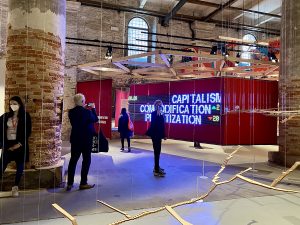
Expanding on Situationist International terminology, it was conceived as a 4-step spatial initiation towards Unitary Urbanism, a term that CohStra had shape for years and redefined as “an anti-capitalist and transdisciplinary practice that attempts to bridge popular and scientific knowledge to co-produce social and environmental justice in cities.” The entrance to the pavilion displayed an artistic rendering of the iconic stock market trading ticker screen. Words related to the effect of capitalism in cities such as gentrification, uneven development, climate change, and patriarchy, among others, are shown as commodities to be traded on the daily markets of contemporary urbanization.
Once inside, Step 1: Reconditioning for Anti-Capitalist Consciousness welcomed people with mirror reflections of the spectator side-to-side with the stock market ticker representing the hegemonic creed that cities can only thrive through economic and profit-driven urban development. This section consisted of four large mirrors that engaged the body with exercises to decondition the audience from such belief. The exercises promoted connecting to others, learning to cooperate, building shared visions, and establishing dialogues with our environment.
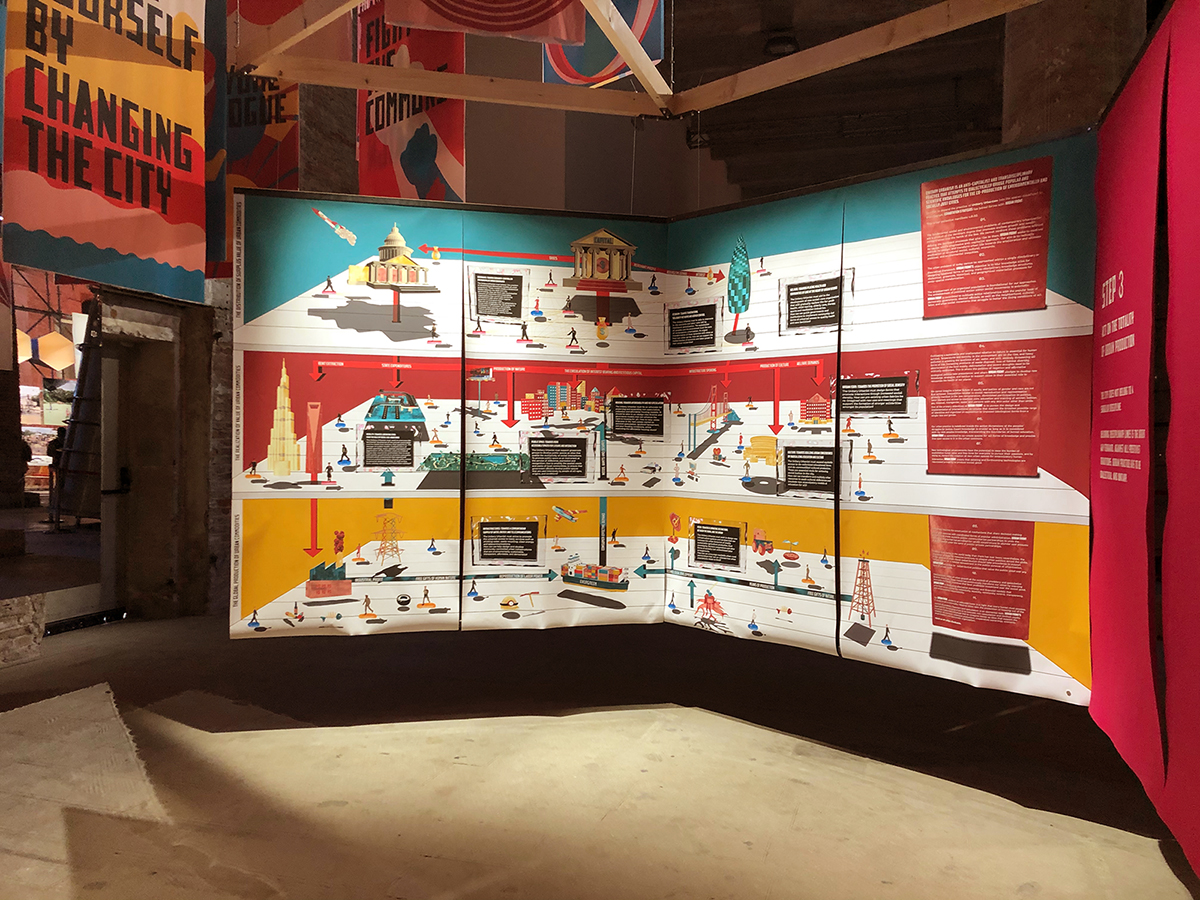
Step 3: Acting on the Totality of Urban Production called for recognizing that the city does not belong to a singular discipline and a Unitary Urbanism. In this section a very large three-dimensional diagram renders the three circuits of capitalist production in urbanization: the production of urban commodities, the circulation of capital in urbanization, and the realization of money-power in cities. The diagram showed how the urban practice of the future must operate within the totality of the three circuits and not just in the narrow focus of disciplinary specializations. This space encouraged viewers to think beyond isolated solutions, highlighting the necessity of a holistic, unitary approach to urban transformation.
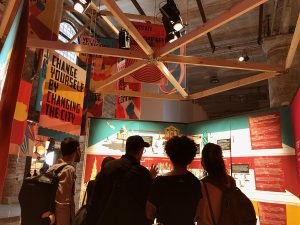
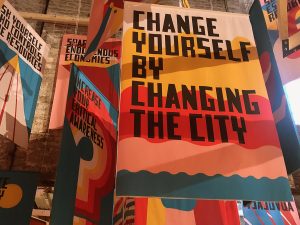
The last one, Step 4: Inciting Collective Imagination, urged the audience to accept that each of us is responsible for enacting the paradigm change towards Unitary Urbanism. It consisted of four large mirrors that reflected the audience and 34 large colorful flags hanging on top of it. The flags displayed messages that incite a renewed sense of collective imagination. Against dystopian thought, it called urgently to begin again by imagining the world we want ourselves and the future generations to live in.
This project marked the second last project under the Cohabitation Strategies banner. To advance the Unitary Urbanism proposed at the exhibition, Emiliano Gandolfi, Gabriela Rendón, and Miguel Robles-Durán realized Cohabitation Strategies needed to expand and evolve into a more ambitious practice. They united forces with Urban Front—a new entity envisioned in 2019 together with Marxist geographer David Harvey and over twenty highly experienced urbanists active across Asia, Europe, North, and South America. This merger was conceived to create a stronger platform with a robust transdisciplinary foundation, ideally positioned to enhance our rethinking of urban praxis in a more integrated, strategic, and impactful manner by working with progressive governments worldwide.
collaborators
Irtiza Ahmed Chaudhry, Macarena Derra, Sara Devic, Henar Diez, Niccolò Gandolfi, Mia Meus, Juan Pablo Pemberty, Danielle Rosales (Visual Intelligence), Eva Sauer, Sean Scanlan, Jill Shah, Marcello Spada, and Tee Topor.
Entities: La Biennale di Venezia.